
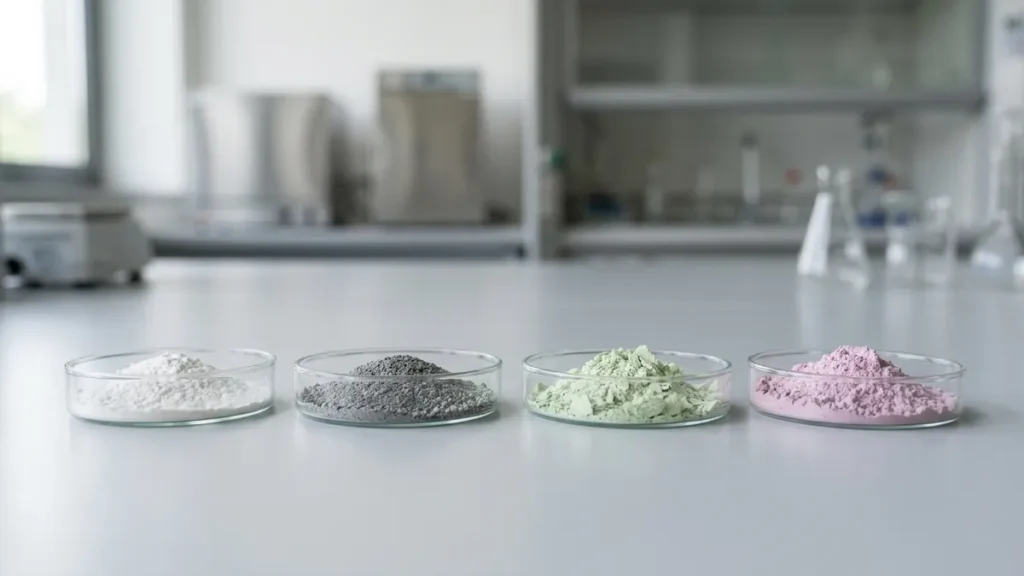
Rare earth elements are a group of 17 metals: the 15 lanthanides on the periodic table plus scandium and yttrium. Despite the name, most of them aren’t especially rare in the Earth’s crust. What’s rare is finding them concentrated enough to mine profitably, and being able to separate them from one another, which is slow, expensive and chemically demanding. That separation step, more than the mining, is why a small group of metals has become a big geopolitical and investment story.
This guide covers what investors actually need to know: which elements matter, what they’re used for, where they come from, how ore becomes a magnet, and why prices and share prices move the way they do.
Light and heavy: the split that matters for prices
Rare earths are usually divided into two families. Definitions vary slightly, but a common split is:
- Light rare earths: lanthanum, cerium, praseodymium, neodymium, promethium, samarium and europium. They are more abundant and make up most of what is mined.
- Heavy rare earths: gadolinium through lutetium, plus yttrium. They are scarcer, more valuable per kilogram and, today, mostly separated in China.
The distinction matters because the two families have different buyers, prices and supply risks. China’s April 2025 export controls, for example, targeted seven medium and heavy rare earths, not the light ones.
The elements investors hear about most
| Element | Family | Main uses | Why investors care |
|---|---|---|---|
| Neodymium (Nd) and praseodymium (Pr) | Light | Permanent magnets in EV motors, wind turbines, electronics | Usually traded together as NdPr oxide; the sector’s benchmark price |
| Dysprosium (Dy) and terbium (Tb) | Heavy | Added to magnets so they keep working at high temperatures | Scarce, expensive and under Chinese export licensing |
| Samarium (Sm) | Light/medium | Samarium-cobalt magnets used in defense and aerospace | Under Chinese export licensing since April 2025 |
| Lanthanum (La) and cerium (Ce) | Light | Refinery catalysts, glass polishing, alloys | Abundant and cheap; often a by-product that dilutes a mine’s average price |
| Yttrium (Y) | Heavy | Ceramics, coatings, phosphors, lasers | Small market, but important in specialized industrial uses |
| Gadolinium (Gd) | Heavy | Medical imaging contrast agents, specialty alloys | Niche demand |
Magnets are the core of the investment case. According to the US Geological Survey, magnets were the leading global use of rare earths in 2025. That’s why neodymium and praseodymium, the main magnet ingredients, drive most of the value of a typical rare earth mine, even though they’re only a minority of the tonnes coming out of the ground.
Where rare earths are mined
| Country | Mine production 2025 (t REO, estimated) | Reserves (t REO) |
|---|---|---|
| China | 270,000 | 44,000,000 |
| United States | 51,000 | 1,900,000 |
| Australia | 29,000 | 6,300,000 |
| Burma (Myanmar) | 22,000 | Not available |
| Thailand | 4,800 | Not available |
| India | 2,900 | Not available |
| Brazil | 2,000 | 21,000,000 |
| Russia | 2,600 | 3,800,000 |
| Vietnam | 150 | 3,500,000 |
| World (rounded) | 390,000 | More than 85,000,000 |
Source: USGS Mineral Commodity Summaries 2026. REO = rare earth oxide equivalent. China’s figure is its official production quota and does not include undocumented production.
Three things stand out. China mined about 69% of the world’s rare earths in 2025. The United States is now the second-largest miner, almost entirely thanks to MP Materials’ Mountain Pass mine in California. And Brazil has the world’s second-largest reserves but produces very little so far, which is why it appears in so many “next frontier” stories.
From rock to magnet
Mining is only the first of several steps, and each one is a different business:
- Mining and concentrating. Ore is dug up and crushed, and the rare earth minerals (such as bastnaesite or monazite) are concentrated.
- Separation. The concentrate is dissolved and run through hundreds of solvent extraction stages to split the elements apart into individual oxides. This is the hardest and most polluting step, and the one China dominates most.
- Metal and alloy making. Oxides are reduced to metals and blended into alloys.
- Magnet manufacturing. Alloys are turned into finished magnets, mostly neodymium-iron-boron (NdFeB) magnets.
A company that only mines sells a lower-value product and usually depends on someone else, historically in China, to separate it. Companies that separate their own output, such as Lynas and MP Materials, capture more value and are rarer. A few are now moving into magnets as well.
Why the United States still depends on imports
Mining in the US has grown, but the country still imports most of the separated compounds and metals it uses. The USGS estimates US net import reliance for rare earth compounds and metals at 67% of consumption in 2025. Between 2021 and 2024, about 71% of those imports came from China, followed by Malaysia (13%), where Lynas processes its Australian ore.
What has happened to prices
The USGS reports these average prices for NdPr oxide (99% minimum, free on board, source Argus Media):
| Year | NdPr oxide, average $/kg |
|---|---|
| 2021 | 92 |
| 2022 | 124 |
| 2023 | 75 |
| 2024 | 55 |
| 2025 | 69 |
That’s a fall of more than half from 2022 to 2024, followed by a partial recovery as Chinese export controls and supply-security concerns pushed prices back up. The swings explain a lot about rare earth share prices: when your main product halves in price over two years, profits can disappear. We follow the latest price moves in our neodymium price outlook.
Why markets care so much
Put the pieces together and you get a market that behaves differently from most commodities:
- It’s small. About 390,000 tonnes a year is tiny next to copper’s roughly 23 million tonnes, so modest changes in supply or demand move prices a lot.
- It’s concentrated. One country dominates mining and, even more, separation and magnet making.
- It’s opaque. There’s no big public exchange; prices are assessed by specialist agencies and many deals are private.
- It’s political. Governments treat rare earths as strategic. Export controls, price floors and state funding can change a company’s outlook overnight, as we explain in China rare earth export controls in 2026.
For investors, that combination means opportunity and risk arrive together. If you’re ready to look at the practical side, our guide on how to invest in rare earth elements walks through ETFs, individual stocks and the main risks.