
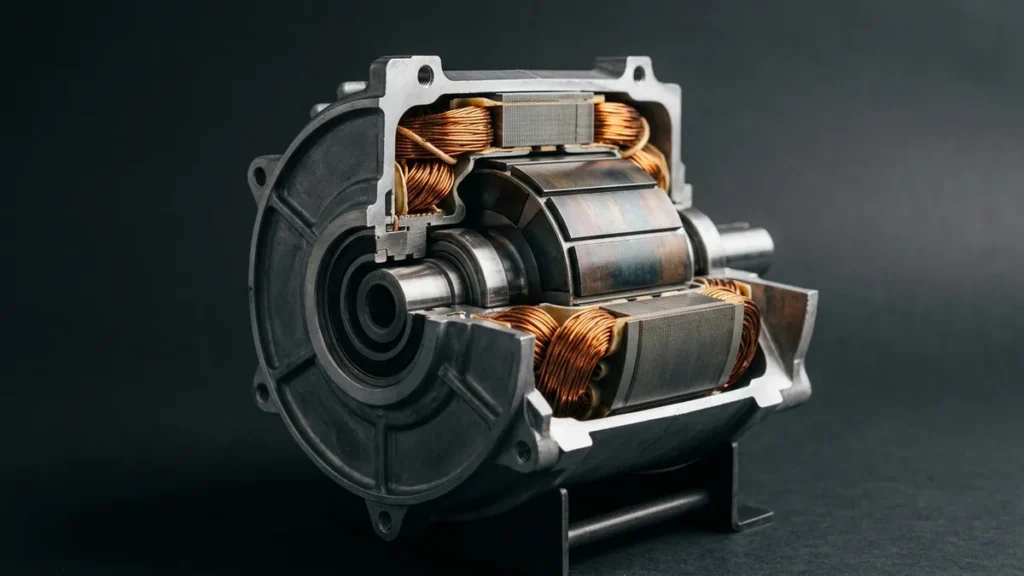
A modern car can’t leave the factory without rare earth permanent magnets, whether it runs on a battery or on petrol. Around 94% of the world’s sintered magnets were made in China in 2024, according to the International Energy Agency. That turns magnet supply into a hidden risk for automaker stocks, and an opportunity for the few companies making magnets elsewhere. The 2025 export controls showed how quickly a shortage of a small, cheap part can stop a production line.
Where magnets sit in a car
The best-known use is the traction motor in most electric vehicles, which typically uses neodymium-iron-boron magnets, often with some dysprosium or terbium so they survive high temperatures. But magnets are spread throughout modern vehicles, including petrol cars: electric power steering, braking systems, seat motors, window lifts, fuel pumps, speakers and sensors.
That’s why the supply question isn’t only an EV question. A carmaker can have every major component ready and still be unable to finish a vehicle because one supplier ran out of a small motor.
What 2025 showed
After China introduced export licences for seven medium and heavy rare earths and related magnets in April 2025, shipments slowed while companies waited for approval. The effects reached factories within weeks:
- Ford paused production of the Explorer SUV at its Chicago plant for a week in May 2025 after a supplier ran out of magnets. CEO Jim Farley later described supply as “hand-to-mouth”.
- European suppliers warned that the restrictions were already stopping some production lines, and Suzuki halted some models because of a parts shortage, according to Japanese press reports.
Supply improved once licences were granted and a US–China truce was agreed, but the episode showed investors how exposed carmakers are. We explain the rules and what’s still in force in China rare earth export controls in 2026.
How concentrated the supply chain is
The IEA estimates China’s share of each stage in 2024:
| Stage | China’s share (2024) |
|---|---|
| Mining of magnet rare earths | About 60% |
| Refining of magnet rare earths | About 91% |
| Sintered permanent magnet production | About 94% |
Source: IEA, Rare Earth Elements report, 2026.
The IEA also estimated that, if China’s 2025 export controls were implemented in full, downstream production worth about $6.5 trillion a year outside China would be at risk. And it found that existing and announced projects outside China would meet less than a fifth of the region’s magnet demand by 2035. In other words, magnet making, not mining, is the biggest bottleneck.
Which stocks are exposed, and how
| Group | Examples | How magnet supply affects them |
|---|---|---|
| Automakers | Ford, GM, European and Japanese carmakers | Exposed to shortages and higher costs; most depend on Chinese magnets through their suppliers |
| Magnet makers outside China | MP Materials (US), Neo Performance Materials (Estonia), Energy Fuels (agreed in 2026 to buy German magnet maker VAC) | Potential beneficiaries as carmakers seek non-Chinese supply; must prove they can make qualified magnets at scale |
| Rare earth producers | Lynas, MP Materials, Iluka | Benefit indirectly as demand for non-Chinese oxides grows |
| Alternative motor designs | Carmakers using motors without rare earth magnets | Reduce dependence, but usually with trade-offs in size, weight or efficiency |
A few concrete links between the two worlds already exist. MP Materials began delivering magnets to General Motors for qualification and expected commercial shipments from the fourth quarter of 2026. Neo’s plant in Estonia has won supply contracts for EV traction motors with European suppliers. We look at Neo in detail in our Neo Performance Materials stock review.
The other side: designing magnets out
Carmakers aren’t just waiting for new supply. Some already use electric motors without permanent magnets, such as electrically excited motors, and others are working to cut the amount of dysprosium and terbium per magnet. Tesla said in 2023 that it planned a future drive unit with no rare earths at all. If these designs spread, demand growth for rare earth magnets in cars could be slower than many forecasts assume. That’s a risk worth weighing for any rare earth investment built mainly on the EV story.
What investors can watch
- Licence news from China, especially around January 10, 2027, when both the US–China trade truce and China’s suspension of its October 2025 controls are due to end.
- US defense procurement rules that start restricting Chinese-origin magnets from January 2027.
- Qualification announcements: when a Western magnet maker passes a carmaker’s tests and starts commercial deliveries.
- Automaker commentary in quarterly results about parts shortages or rare earth costs.
For investors, the takeaway is that magnet supply is now a factor in auto stocks as well as mining stocks. The companies best placed are those that can make qualified magnets outside China at scale, and that list is still very short.