
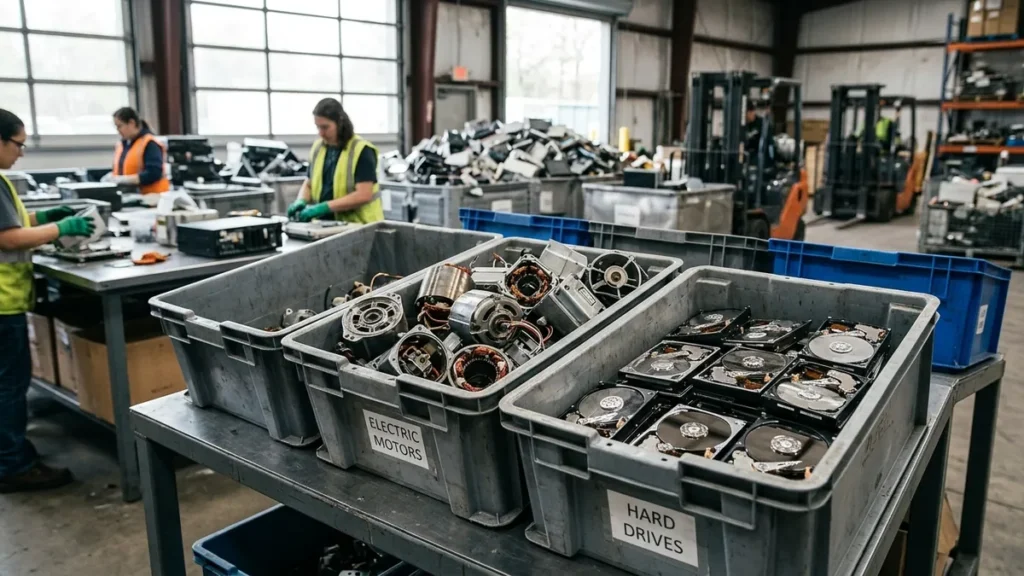
Search for rare earth recycling stocks and you’ll quickly notice that the companies doing it at scale, such as Cyclic Materials and Noveon Magnetics, are private. Listed “pure plays” barely exist. On the stock market, exposure mostly comes through larger companies adding recycling to their business: MP Materials (recycled magnets for Apple), USA Rare Earth (recycling magnet scrap and a stake in a French recycler) and Mkango Resources (owner of the UK recycler HyProMag). Recycling is real and growing, but still small, so it works better as a feature of a company than as a reason on its own to buy.
Why recycling matters
Rare earth magnets are in electric motors, wind turbines, hard drives, MRI machines and consumer electronics. Recovering the neodymium, praseodymium, dysprosium and terbium inside them has two attractions:
- Supply outside China. Old magnets and factory scrap are a source of rare earths that doesn’t depend on Chinese mines or Chinese export licences.
- Heavy rare earths. Recycled magnets often contain dysprosium and terbium, the scarcest and most tightly controlled elements.
The limits are just as real. Most magnets are locked inside products that last for years, so the volume of end-of-life material is still small compared with new demand, and collecting and dismantling it is costly.
Two main ways to recycle magnets
- Magnet-to-magnet (hydrogen processing): old magnets are broken down with hydrogen into a powder that can be made directly into new magnets. It uses less energy but needs relatively clean, sorted scrap. HyProMag is a leading example.
- Back to oxides (hydrometallurgy): scrap is dissolved and the rare earths are separated chemically, producing oxides that can go anywhere in the supply chain. It handles messier feedstock but needs a separation plant. Cyclic Materials and USA Rare Earth’s Colorado facility use this route.
There’s also an important difference in what’s being recycled: factory scrap (called swarf, the grinding waste from making magnets) is cleaner and more predictable than end-of-life magnets pulled from old products.
Listed companies with recycling exposure
| Company | Listing | Recycling activity |
|---|---|---|
| MP Materials | NYSE: MP | Agreed in July 2025 to supply Apple with US-made magnets from recycled material, with a dedicated recycling line at Mountain Pass; shipments expected from 2027 |
| USA Rare Earth | Nasdaq: USAR | Its Wheat Ridge, Colorado facility produced commercial-grade dysprosium oxide and NdPr oxide samples from recycled magnet swarf in July 2026; strategic investment in France’s Carester, whose Lacq plant is designed to process 2,000 t/yr of end-of-life magnets |
| Mkango Resources | AIM and TSXV: MKA | Controlling owner, through Maginito, of HyProMag, which runs hydrogen-based magnet recycling in the UK and Germany and is developing a US plant |
| American Resources | Nasdaq: AREC | Parent of ReElement Technologies, a US rare earth refining and recycling business |
Sources: company filings and announcements. Companies are examples for educational purposes, not recommendations.
For MP and USA Rare Earth, recycling is a small part of much larger businesses, and both also receive significant US government support, which we cover in US government-backed rare earth stocks. For Mkango and American Resources, recycling is a bigger part of the story, but these are small companies with the risks that come with that.
Government support for recycling
Governments see recycling as a quick way to add supply. According to the US Geological Survey, in 2025 the US Department of War made an $80 million loan to a rare earth recycler in Indiana and awarded $5.1 million to another in Texas to recover rare earths, including terbium and dysprosium. Europe has set its own targets for recycled content under its Critical Raw Materials Act. That support helps the economics, but it doesn’t guarantee that any particular company succeeds.
Risks to keep in mind
- Scale. Recycling plants are small next to mines and separation plants; even successful ones supply a fraction of demand.
- Feedstock. Secure, steady supplies of scrap are hard to lock in, and competition for them is growing.
- Prices. Recycling economics improve when rare earth prices are high and suffer when they fall.
- Most leaders are private. The companies furthest ahead aren’t available on the stock market, and some may list later at high valuations.
How to approach it as an investor
If recycling interests you, the most practical route is to own companies where it strengthens an existing business, then watch for milestones: commercial volumes, signed customers and the share of feedstock coming from recycled material. For the scarcest elements recycling can recover, see how to invest in dysprosium and terbium. For MP’s wider business, including the Apple agreement, see Is MP Materials a good investment?