
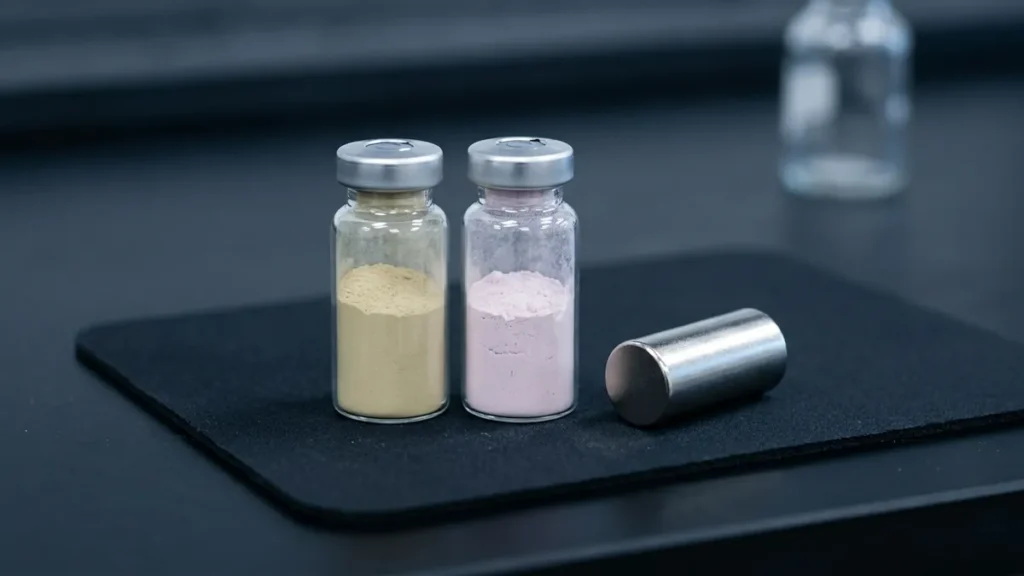
You can’t easily buy dysprosium or terbium themselves, so investors get exposure through the few companies that produce or plan to produce them. Outside China, that list is short: Lynas Rare Earths is the only company separating them at commercial scale today, while MP Materials, Energy Fuels, Iluka Resources and USA Rare Earth are at various stages of building capacity. The investment case rests on scarcity and Chinese export controls; the risks are tiny volumes, prices set largely in China and projects that haven’t been proven yet.
Why dysprosium and terbium matter
Most of the value in a rare earth magnet comes from neodymium and praseodymium (NdPr). But a standard neodymium magnet loses strength as it heats up. Adding small amounts of dysprosium or terbium keeps it working at the high temperatures found inside electric vehicle motors, wind turbines, industrial motors and defense equipment. The quantities are small, but there’s no easy substitute in many high-performance applications.
Heavy vs light rare earths: why the difference matters to investors
| Light rare earths (e.g. NdPr) | Heavy rare earths (e.g. dysprosium, terbium) | |
|---|---|---|
| Abundance | More common in most ore bodies | Much scarcer; concentrated in certain ores such as ionic clays |
| Price per kilogram | Tens of dollars | Hundreds (dysprosium) to over a thousand (terbium) |
| Separation outside China | Several producers (Lynas, MP) | Essentially one commercial producer (Lynas) |
| Chinese export controls (April 2025) | Not on the list | Licences required |
| What drives the price | Magnet demand, Chinese supply, sentiment | Chinese licensing decisions and very limited alternative supply |
For investors, that means heavy rare earth exposure is a more concentrated bet on supply security and policy than on demand alone. For more on the full group of elements, see rare earth elements explained for investors.
What prices have done
The US Geological Survey reports these average prices (free on board, from Argus Media and Asian Metal):
| Year | Terbium oxide (99.99%), $/kg | Dysprosium oxide (99.5%), $/kg |
|---|---|---|
| 2021 | 1,340 | 410 |
| 2022 | 2,050 | 382 |
| 2023 | 1,300 | 330 |
| 2024 | 812 | 257 |
| 2025 | 1,010 | 239 |
Source: USGS Mineral Commodity Summaries 2026, Rare Earths (Heavy).
Two things stand out. Terbium is far more volatile than dysprosium: it lost more than 60% from 2022 to 2024 before recovering. And these benchmark prices largely reflect material traded in or from China. Since the April 2025 export controls, buyers outside China have at times paid well above these levels, because licensed supply is limited. The USGS also notes that the US imported 100% of its terbium compounds and metals from China between 2021 and 2024.
The companies building supply outside China
| Company | Listing | Where it stands on dysprosium and terbium |
|---|---|---|
| Lynas Rare Earths | ASX: LYC | Producing in Malaysia since 2025, the first commercial producer of separated heavy rare earths outside China; expanding its Malaysian heavy rare earth circuit |
| MP Materials | NYSE: MP | Building heavy rare earth separation at Mountain Pass, supported by a $150 million US Department of Defense loan (August 2025) |
| Energy Fuels | NYSE American: UUUU | Pilot production at its Utah mill (29 kg of dysprosium oxide by September 2025); a proposed expansion targets roughly 165 t/yr of dysprosium and 50 t/yr of terbium |
| Iluka Resources | ASX: ILU | Eneabba refinery planned to produce around 750 t/yr of dysprosium and terbium oxide; commissioning in 2027 |
| USA Rare Earth | Nasdaq: USAR | Agreed in April 2026 to buy Serra Verde, a Brazilian mine producing concentrate rich in heavy rare earths |
Lynas is the only name on this list where heavy rare earths already add to revenue. Everywhere else, you’re buying a plan. Iluka’s refinery is the largest planned heavy rare earth capacity in the group; we look at it in detail in Is Iluka Resources a buy for rare earth exposure?
Ways to invest, from most to least direct
- Producers with heavy rare earth output today. Lynas is the only one at commercial scale.
- Companies building capacity. MP Materials, Energy Fuels, Iluka and USA Rare Earth. Their heavy rare earth plans are a smaller part of a bigger business, and timelines can slip.
- Funds. ETFs like REMX hold several of these companies, but heavy rare earths are a tiny slice of any fund’s exposure.
- The metals themselves. For individual investors there’s no practical, liquid market, and physical metals can’t be held in an IRA.
The risks specific to heavy rare earths
- Tiny volumes. Global heavy rare earth markets are measured in hundreds or low thousands of tonnes. A single contract or policy change can move prices dramatically.
- China sets the tone. Most supply and most published prices still come from China, and its licensing decisions can change the market overnight. We follow the rules in China rare earth export controls in 2026.
- Unproven projects. Separating heavy rare earths is harder than separating NdPr. Pilot success doesn’t guarantee commercial output.
- Substitution. Magnet makers are working to reduce how much dysprosium and terbium they need. Over time, that could cap demand.
The practical takeaway: heavy rare earths can add a distinctive angle to a rare earth position, but they’re best treated as part of a broader holding rather than the whole thing.