
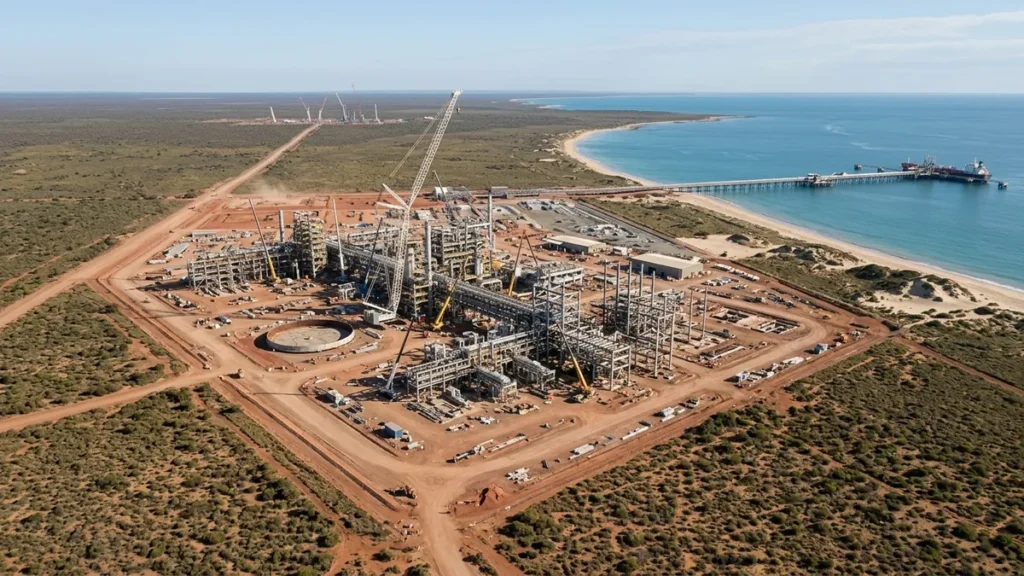
Iluka Resources (ASX: ILU) doesn’t produce rare earths yet. Today it’s a mineral sands company that sells zircon and titanium feedstocks, and it’s building one of the largest rare earth refineries outside China at Eneabba, in Western Australia, due to be commissioned in 2027. So buying Iluka for rare earths really means buying a construction project attached to a cyclical mineral sands business. Whether that appeals to you depends on your time horizon, and on how much you trust the refinery to start on time and on budget.
Here’s what the company does now, what Eneabba will add, what the latest numbers show and the risks on each side.
What Iluka does today
Iluka mines mineral sands in Australia and sells two main product groups: zircon, used in ceramic tiles and other industrial products, and titanium feedstocks (rutile and synthetic rutile), used in pigments and titanium metal. It also owns a stake in Deterra Royalties. None of that is rare earths, and it’s what pays the bills while the refinery is built.
The first half of 2026 was weak for mineral sands. Results released on August 19, 2026 showed:
| Measure (A$) | First half 2026 | First half 2025 |
|---|---|---|
| Mineral sands revenue | $433m | $558m |
| Underlying mineral sands EBITDA | $41m | $218m |
| Profit (loss) after tax | $(24)m | $92m |
| Mineral sands free cash flow | $200m | $(192)m |
| Interim dividend | 3 cents | 2 cents |
| Net debt at June 30, 2026 (A$) | |
|---|---|
| Mineral sands business | $273m (down from $473m at December 31, 2025) |
| Rare earths business | $877m (up from $584m) |
Source: Iluka Resources 2026 Half Year Results, ASX, August 19, 2026.
Earnings fell sharply, but cash flow improved and mineral sands debt came down. Iluka also brought its new Balranald mineral sands mine into operation, with the ramp-up continuing through the second half.
The Eneabba refinery: what Iluka is building
Eneabba is the reason Iluka appears on rare earth watchlists:
- What it will produce: separated rare earth oxides, both light (neodymium and praseodymium, NdPr) and heavy (dysprosium and terbium), the four main magnet elements. Iluka has described capacity of about 5,500 tonnes a year of NdPr oxide and 750 tonnes a year of dysprosium and terbium oxide.
- Feedstock: a large stockpile of rare earth-bearing minerals (monazite and xenotime) already at Eneabba, plus other sources Iluka has been securing.
- Progress: 60% built at June 30, 2026, with all major equipment on site and about A$1.1 billion spent. Iluka says it’s on schedule and on budget, with commissioning in 2027.
- Funding: a non-recourse loan of up to A$1.65 billion from the Australian government’s Export Finance Australia. “Non-recourse” means the lender’s claim is on the rare earth project, not the rest of Iluka.
- First customer: in 2026 Iluka signed its first offtake agreement, with a global automotive company, covering both light and heavy magnet rare earth oxides and starting in 2028.
That combination of heavy rare earths, government funding and a confirmed customer is unusual outside China, where only Lynas currently separates heavy rare earths at commercial scale.
The case for Iluka as rare earth exposure
- Heavy rare earths. Dysprosium and terbium are the scarcest and most tightly controlled magnet elements. Few planned refineries outside China will make them at Eneabba’s intended scale.
- A business that already exists. Unlike a pure developer, Iluka has revenue, a dividend and an operating history while it builds.
- Government backing. The A$1.65 billion loan lowers the risk that the refinery runs out of money mid-construction.
- Timing. Commissioning in 2027 lines up with Western efforts to reduce reliance on China.
The case against
- No rare earth revenue yet. Until Eneabba runs, the share price will mostly follow zircon and titanium markets, which were weak in early 2026.
- Construction and ramp-up risk. Separation plants are complex. Even after commissioning, reaching design output can take a long time, as Lynas’s own history shows.
- Rising rare earth debt. Net debt in the rare earth business grew to A$877 million by June 2026 and will keep rising until the refinery earns money.
- Price exposure. Iluka doesn’t have a government price floor like MP Materials; its future earnings depend on NdPr and heavy rare earth prices.
How Iluka compares with the established producers
| Iluka | Lynas | MP Materials | |
|---|---|---|---|
| Separating rare earths today? | No, from 2027 | Yes | Yes |
| Heavy rare earths | Planned at Eneabba | Producing in Malaysia | Being commissioned |
| Other businesses | Mineral sands (zircon, titanium) | None significant | Magnets |
| Main listing | ASX: ILU | ASX: LYC | NYSE: MP |
For the two producers, see MP Materials vs Lynas Rare Earths. If you’re comparing Iluka with the wider field, our list of best rare earth stocks in 2026 puts it alongside the other names investors watch.
How US investors can buy Iluka
Iluka’s main listing is on the Australian Securities Exchange under ILU, so you’ll need a broker with ASX access. The steps and costs are the same as for Lynas, which we walk through in how to buy Lynas Rare Earths stock in the US. Iluka is also one of the holdings in the VanEck Rare Earth and Strategic Metals ETF (REMX), at about 3.6% of the fund in mid-October 2026.
Who Iluka tends to suit
Iluka fits investors who want heavy rare earth exposure, can wait until at least 2027 to see whether the refinery delivers, and are comfortable owning a mineral sands business in the meantime. It’s a poor fit for anyone who wants rare earth earnings now or can’t tolerate a weak mineral sands cycle.