
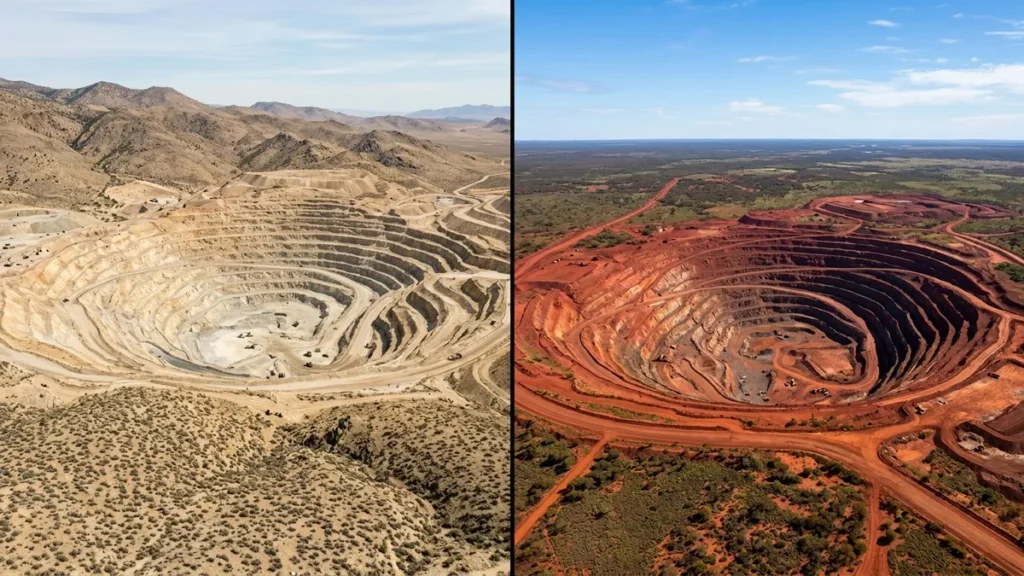
Last updated: October 18, 2026. Figures come from each company’s latest annual results. Note that they use different financial years and currencies.
Ask investors which rare earth companies outside China matter most, and two names come up almost every time: MP Materials in the United States and Lynas Rare Earths in Australia. Both separate rare earths at commercial scale, both sell to customers who want supply that doesn’t depend on China, and both move sharply when rare earths are in the news. But they are different businesses, at different stages, with different risks.
This isn’t a “buy this one” article. We don’t make price predictions or give price targets. The goal is to compare the two on the facts.
The short version
- Lynas is bigger and already profitable. It produced 7,260 tonnes of NdPr in the year to June 2026 and earned a net profit of A$222.4 million.
- MP is growing fast and has a government safety net. It produced 2,599 tonnes of NdPr in 2025, roughly double the year before, and has a ten-year $110/kg NdPr price floor from the US Department of Defense.
- Lynas is further ahead in heavy rare earths, with commercial dysprosium and terbium production in Malaysia. MP is still bringing heavy rare earth separation online.
- MP is going further downstream into magnets, with supply deals with General Motors and Apple.
- For US investors, MP is simpler to buy. Lynas trades mainly on the ASX.
Side-by-side snapshot
| MP Materials | Lynas Rare Earths | |
|---|---|---|
| Main listing | NYSE (MP) | ASX (LYC) |
| Mine | Mountain Pass, California | Mt Weld, Western Australia |
| Main processing | Mountain Pass (separation), Fort Worth, Texas (metal and magnets) | Kalgoorlie, Australia, and Gebeng, Malaysia |
| Latest annual NdPr production | 2,599 t (calendar 2025) | 7,260 t (year to June 30, 2026) |
| Latest annual revenue | US$224.4M (2025) | A$977.9M (FY26) |
| Latest annual net result | Net loss of US$85.9M (2025) | Net profit of A$222.4M (FY26) |
| Heavy rare earths | Separation being commissioned in 2026 | Dysprosium and terbium in production; first samarium oxide in March 2026 |
| Government links | DoD shareholder, $110/kg NdPr price floor, magnet offtake | Long-term supply agreements with government-backed partners in Japan and the US |
Sources: MP Materials Q4 and full year 2025 results; Lynas Rare Earths 2026 Annual Report.
MP Materials: the US mine-to-magnet story
MP’s pitch is integration: mine, separate, make metal and make magnets, all in the United States. Since July 2025 it has had a partnership with the Department of Defense that includes a price floor of $110 per kilogram for its NdPr through 2035 and a commitment to buy all output from a planned large magnet plant (the “10X Facility”) in Texas, targeted for commissioning in 2028. It also has a $500 million supply agreement with Apple.
The numbers are moving quickly. NdPr production doubled in 2025, and the company produced 917 tonnes in the first quarter of 2026 alone. But it was still loss-making for 2025 as a whole, and a large share of its 2026 income has come from the government price floor rather than from market sales. We look at what that means in Is MP Materials a good investment?
Lynas: the established producer
Lynas has been producing separated rare earths outside China for over a decade. It mines at Mt Weld, processes in Kalgoorlie and Malaysia, and is the only commercial-scale producer of separated heavy rare earths outside China.
The year to June 2026 was its best yet. Revenue rose to A$977.9 million from A$556.5 million, and net profit jumped to A$222.4 million from A$8.0 million, helped by a record average selling price of A$80.7 per kilogram. Lynas noted that the China domestic NdPr price (excluding VAT) rose from US$55.0/kg in June 2025 to US$100.8/kg in June 2026.
It isn’t without problems. NdPr output of 7,260 tonnes is still well below the roughly 10,500 tonnes a year its Malaysian plant is designed for, and ore variation issues hit processing in the June 2026 quarter. Lynas also reports in Australian dollars, so currency moves affect what US investors see.
The differences that actually matter
1. Profitability today. Lynas is profitable on market prices. MP’s results lean on the government price floor while it ramps up.
2. Exposure to prices. MP’s floor protects it if NdPr falls below $110/kg, but it will share part of any upside above that level once 10X is at full capacity. Lynas is more directly exposed to market prices, in both directions.
3. Heavy rare earths. Dysprosium and terbium are scarcer and more tightly controlled by China. Lynas already sells them; MP is still building that capability.
4. Downstream reach. MP is betting heavily on magnets. Lynas has focused on oxides and has signed agreements with downstream partners rather than making magnets at scale itself.
5. Political risk. Both benefit from Western efforts to diversify away from China. On June 22, 2026, China added MP Materials to its export control list. Lynas, meanwhile, depends on its operating licence and conditions in Malaysia.
6. Ease of access. MP is a standard US purchase. Lynas requires a broker with ASX access or an OTC listing, which we explain in how to buy Lynas Rare Earths stock in the US.
Shared risks
- NdPr prices are volatile and not set on a single transparent exchange.
- Chinese policy can move the whole sector in a day.
- Expansion projects run late and over budget.
- Share prices often react more to headlines than to results in the short term.
How to research them yourself
1. MP Materials: the 10-K and quarterly releases on SEC EDGAR.
2. Lynas: the annual report and quarterly reports on the ASX announcements platform.
3. Compare like with like: the same metrics (production, revenue, margins, cash, debt), and adjust for the different financial years and currencies.
4. Read the risk sections before the highlights.
If you’d like to compare MP with another US name, see Energy Fuels vs MP Materials.
The bottom line
Lynas is the proven producer; MP is the fast-growing challenger with a government safety net. Neither is a sure thing. Read the latest results, compare the same numbers side by side, and be clear about which set of risks you’re choosing.