
Last updated: October 18, 2026. Figures come from MP Materials’ own filings and releases; dates are given for each.
MP Materials is the most direct way to own US rare earth production, and since July 2025 it has had something no other rare earth miner has: a US government price floor that limits how bad NdPr pricing can get for its own output. That protects the downside of its sales, not of its shares. Whether it’s a good investment comes down to two things nobody can promise: how well it executes a demanding expansion into magnets, and how much of that success is already in the price after its large rise since mid-2025.
Below are the facts behind both sides of the debate: what the company does, what changed, how the numbers have moved and what can go wrong.
What MP Materials does
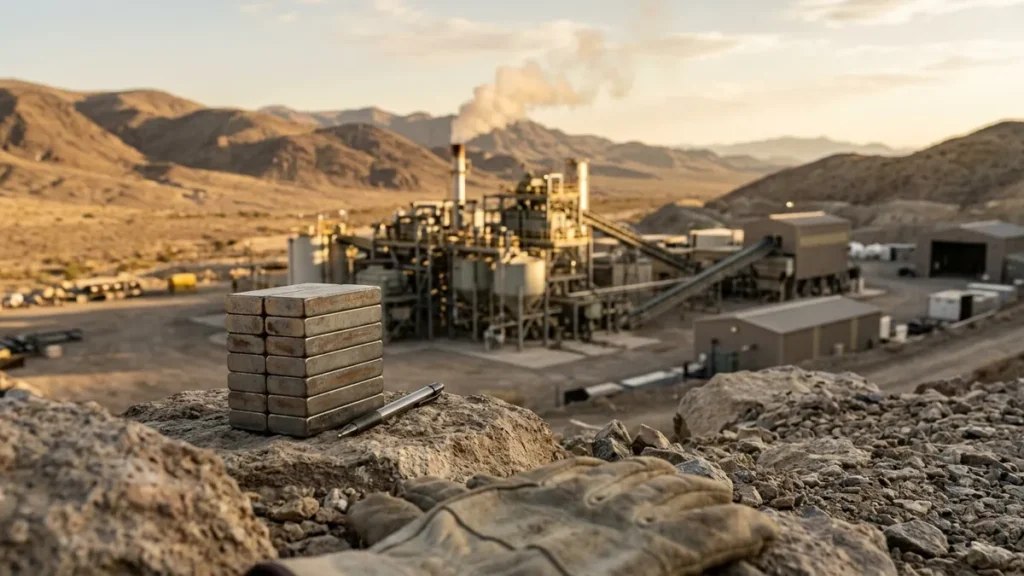
MP Materials (NYSE: MP) owns and operates Mountain Pass in California, the only large-scale rare earth mining and processing site in North America. For years the company mostly sold rare earth concentrate, much of it to China for processing. Its strategy now is to keep more of the value at home: separate the concentrate into neodymium-praseodymium (NdPr) oxide at Mountain Pass, turn it into metal and magnets at its Independence facility in Fort Worth, Texas, and eventually make magnets at a much larger scale.
What changed in 2025
Three events reshaped the company’s story in the space of a few weeks:
- A partnership with the US Department of Defense (July 2025). The DoD became MP’s largest shareholder through a preferred equity investment of about $400 million. It also agreed a price floor of $110 per kilogram for NdPr: if the market benchmark falls below that level, the government pays MP the difference on the NdPr it produces. According to MP’s filings, the floor runs from October 1, 2025 through December 31, 2035. Once MP’s planned 10X magnet facility reaches full capacity, MP will hand back 30% of any NdPr price above $110.
- A new magnet plant, the “10X Facility”. The DoD agreed to buy all magnets from the plant for ten years after it starts operating, and JPMorgan Chase and Goldman Sachs committed $1 billion of financing. In February 2026 MP said the plant will be built in Northlake, Texas, supported by a $200 million incentive package. Commissioning has been targeted for 2028.
- A $500 million agreement with Apple (July 2025) for US-made magnets from recycled material, with shipments expected to start in 2027.
In the same month, MP stopped selling concentrate to China.
What the numbers show
| Period | NdPr oxide produced | Revenue | Notes |
|---|---|---|---|
| Full year 2024 | 1,294 t | $203.9M (Materials segment) | Weak NdPr prices |
| Full year 2025 | 2,599 t | $224.4M (consolidated) | Net loss of $85.9M; Q4 2025 net income of $9.4M |
| Q1 2026 | 917 t | $90.6M + $42.3M price-floor income | Record quarterly production |
| Q2 2026 | 840 t | $108.5M + $17.6M price-floor income | Planned maintenance outage |
Sources: MP Materials Q4 2025 results (February 26, 2026), Q1 2026 results (May 7, 2026) and Q2 2026 results (August 6, 2026).
Two things stand out. Production has roughly doubled in a year as the separation plant has ramped up. And a meaningful share of income in 2026 has come from the government price floor rather than from sales, especially in the first quarter, when market prices were further below $110. For the third quarter of 2026, management guided to NdPr production above 1,000 tonnes and realized prices in the high-$90s per kilogram.
Why investors are interested
These are the arguments made by people who like the stock. We present them, we don’t endorse them.
- A protected floor. The $110/kg floor limits how bad NdPr pricing can get for MP’s own output for a decade, which is unusual for a commodity producer.
- Vertical integration. MP is moving from mine to oxide to metal to magnet. Each step can capture more value, and magnets for General Motors were expected to start shipping commercially in the fourth quarter of 2026.
- Strategic importance. It is the clearest US-listed way to own the effort to rebuild a domestic magnet supply chain.
What worries people
- Dependence on one site and on policy. Mountain Pass is the heart of the business, and much of the investment case rests on government agreements. Policies can be renegotiated, delayed or politically contested.
- The price floor cuts both ways. It cushions the downside, but MP gives up part of the upside above $110 once the 10X Facility is at full capacity. A good share of 2026 income is a government payment, not a market sale.
- Execution. Ramping a separation plant, two magnet facilities and heavy rare earth separation at the same time is demanding. The Q2 2026 maintenance outage is a reminder that output can dip.
- China’s response. On June 22, 2026, China added MP Materials to its export control list, barring Chinese exporters from supplying it with dual-use items. The direct impact depends on how much MP still relies on Chinese equipment and inputs, which is worth checking in its filings. For the bigger picture, see China rare earth export controls and which stocks are exposed.
- Valuation. After a large share price rise since mid-2025, the market already expects a lot. Good news may be in the price.
A checklist to evaluate it yourself
1. Split revenue from price-floor income. How much of each quarter’s result is sales, and how much is the government payment?
2. Track NdPr output against guidance. Is the company hitting the volumes it promised?
3. Follow the magnet ramp. When do GM and Apple shipments actually start, and at what volumes?
4. Watch the balance sheet. Building 10X is expensive. Check cash, debt and any new share issues.
5. Read the risk factors. The latest 10-K lists them. Read them first, not last.
6. Ask what’s priced in. Compare valuation with the company’s own history and with peers such as Lynas.
How it compares
MP is often compared with Australia’s Lynas, which produces more NdPr and is already profitable. We set the two side by side in MP Materials vs Lynas Rare Earths. If you prefer not to rely on a single company, read whether rare earth investing is risky before deciding how much exposure makes sense.
MP Materials is no longer a simple mining stock. It is a company with a government price floor, two large customers lined up for magnets and a demanding construction schedule. That makes it easier to understand than most rare earth stocks, but not risk-free. Read the latest quarterly release, separate the market income from the government income, and decide whether today’s price leaves room for things to go wrong.