
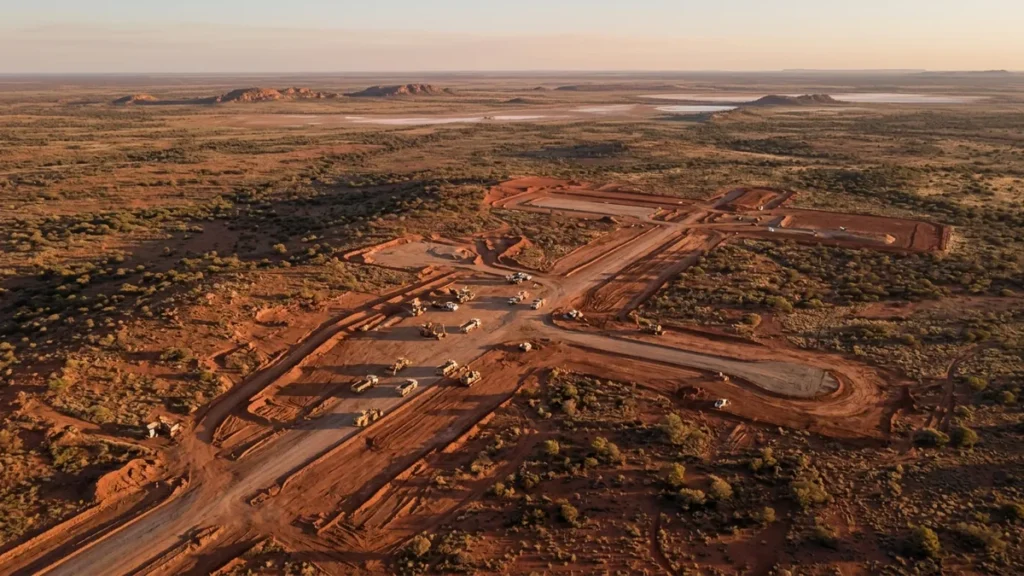
Arafura Rare Earths (ASX: ARU) is a developer, not a producer, but May 2026 changed what kind of developer it is. That month it took the final investment decision on its Nolans project in Australia’s Northern Territory, designed to produce about 4,440 tonnes of NdPr oxide a year from 2029. The project is now funded and mostly sold in advance. Until Nolans is built and running, though, Arafura has no rare earth revenue, and construction risk is the main thing a shareholder is buying.
Nolans in brief
| Location | About 135 km north of Alice Springs, Northern Territory, Australia |
| Final investment decision | May 21, 2026 |
| Construction | Formally starting September 2026; about three years |
| First production | Targeted for early-to-mid 2029 |
| Main product | About 4,440 t/yr of NdPr oxide |
| By-products | Up to about 470 t/yr of mixed medium and heavy rare earth oxide, plus phosphoric acid |
| Project life | About 38 years |
| Offtake contracted at FID | More than 80% of planned NdPr output |
Sources: Arafura announcements, Reuters and Argus reporting on the May 2026 FID.
What makes Nolans unusual is that it’s planned as a fully integrated ore-to-oxide operation in one place: mining, concentrating and separating into NdPr oxide in Australia, without shipping intermediate material to China.
How it’s being paid for
Reuters reported a funding package of about $1.6 billion when the final investment decision was announced. Much of it comes from Australian government lenders and investors, including the Northern Australia Infrastructure Facility, Export Finance Australia and the National Reconstruction Fund, which invested A$200 million in May 2026. Hancock Prospecting, the private company of Australian billionaire Gina Rinehart, owns about 15.5% of Arafura.
Who has agreed to buy the output
Arafura has offtake agreements with Hyundai and Kia, Siemens Gamesa, the commodity trader Traxys (including 500 tonnes a year for North America) and the Australian government, which agreed to buy 500 tonnes a year for a national strategic reserve. Contracting more than 80% of output in advance was one of the conditions for the final investment decision.
The case for Arafura
- Funding risk is largely behind it. Many rare earth developers never get past this stage.
- Scale. At full output, Nolans would produce more NdPr than MP Materials did in 2025, and roughly 4% of current global supply, according to the company.
- Customers lined up. Carmakers and a wind turbine maker have already signed.
- Jurisdiction. Australia is a stable, mining-friendly country actively supporting rare earth projects.
The case against
- Three years of construction. Large processing plants often run late and over budget, and the hardest part, getting a new separation plant to design output, comes after construction.
- No revenue until 2029. Any delay pushes back the first dollar of income.
- Price exposure. Unlike MP Materials, Arafura doesn’t have a government price floor on most of its output; its future profits depend on NdPr prices.
- Debt and dilution. A project of this size is financed with large loans and equity; existing shareholders may be diluted along the way.
How to buy Arafura from the US
Arafura’s main listing is on the Australian Securities Exchange under ARU.
- Use a broker with ASX access, such as Interactive Brokers, Fidelity’s international trading or the Schwab Global Account.
- Fund the trade in Australian dollars or let the broker convert, and check the currency fee.
- Trade during ASX hours, 10 a.m. to 4 p.m. Sydney time, which is evening or night in the US.
- Use a limit order. Developer stocks can move sharply on construction and financing news.
Arafura also has a US over-the-counter listing, but check its trading volume before relying on it. The full process is the same as for Lynas, which we walk through in how to buy Lynas Rare Earths stock in the US.
Who Arafura tends to suit
Arafura fits investors who want exposure to the next wave of NdPr supply outside China, can wait until 2029 for production, and accept the risks of a single large project. If you’d rather own a company already producing, compare it with the producers in best rare earth stocks in 2026, or with Iluka, another Australian company building a refinery, in Is Iluka Resources a buy for rare earth exposure?