
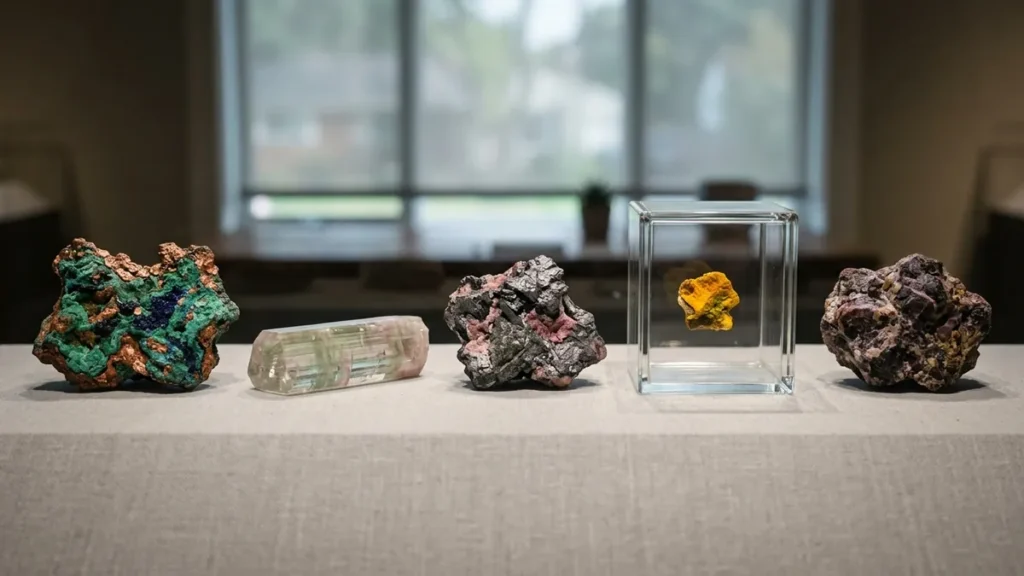
“Critical minerals” isn’t one market. It’s a government label for materials considered vital to the economy and national security, and hard to replace if supply is cut off. The US list was updated in November 2025 and added copper, silver, uranium, potash and several others. For an investor, that means “critical minerals stocks” can mean a lithium producer in Chile, a copper miner in Arizona, a uranium company in Canada or a rare earth refiner in Australia. Those are very different businesses.
The practical way to approach the theme is to choose the segment first, then the company. Below are the five segments investors most often mean, what the latest US Geological Survey data says about each, and example companies listed on major exchanges.
The five segments at a glance
| Mineral | Main use | Where it’s mined (2025) | Example listed companies |
|---|---|---|---|
| Lithium | Batteries (about 88% of global use) | Australia, China, Chile, Zimbabwe, Argentina | Albemarle (NYSE: ALB), SQM (NYSE: SQM), Pilbara Minerals (ASX: PLS) |
| Copper | Power grids, buildings, motors, electronics | Chile, Congo (Kinshasa), Peru, China, Russia | Freeport-McMoRan (NYSE: FCX), Southern Copper (NYSE: SCCO) |
| Cobalt | Batteries, superalloys for jet engines | Congo (Kinshasa) 73%, Indonesia 14% | Mostly a by-product of large copper and nickel miners |
| Uranium | Nuclear power fuel | Kazakhstan is the largest producer | Cameco (NYSE: CCJ), Energy Fuels (NYSE American: UUUU) |
| Rare earths | Permanent magnets for motors and turbines | China 69%, US 13%, Australia 7% | MP Materials (NYSE: MP), Lynas Rare Earths (ASX: LYC) |
Production shares from USGS Mineral Commodity Summaries 2026. Companies are examples for educational purposes, not recommendations.
What the numbers say about each segment
Lithium: a textbook boom and bust
Lithium shows why commodity cycles matter more than headlines. The USGS reports that the average US contract price for battery-grade lithium carbonate went from $11,700 per tonne in 2021 to $63,700 in 2022, then fell to $9,000 in 2025, down 86% from the peak. Production kept rising anyway: world output outside the US grew 31% in 2025 to about 290,000 tonnes, led by Australia (92,000 t), China (62,000 t) and Chile (56,000 t).
For investors, that means lithium producers’ profits swing enormously with prices. Low-cost producers survive the downturns; high-cost ones often don’t.
Copper: the critical mineral everyone already uses
Copper joined the US critical minerals list in 2025. World mine production was about 23 million tonnes in 2025, led by Chile (5.3 million t), Congo (Kinshasa) (3.2 million t) and Peru (2.7 million t). The bigger dependency is refining: China refined about 14 million of the world’s 29 million tonnes of refined copper. Prices were strong in 2025, with COMEX copper projected by the USGS to average a record $4.80 per pound.
Copper miners are large, established companies, so they’re usually less speculative than lithium or rare earth juniors. They still move with the global economy.
Cobalt: one country, one policy decision
Cobalt is the most concentrated of the five. Congo (Kinshasa) mined about 73% of the world’s cobalt in 2025. In February 2025 it temporarily banned exports to support prices, then replaced the ban in October with quotas of up to 96,600 tonnes a year for 2026 and 2027. China is the leading refiner and consumer. There are very few listed “pure” cobalt companies; most cobalt comes as a by-product of copper and nickel mining, so cobalt exposure usually arrives inside a larger miner.
Uranium: policy-driven demand
Uranium was added to the US critical minerals list in 2025. Demand depends on nuclear power plans, which change with government policy and can take years to turn into reactor orders. Uranium companies range from large producers to small explorers. Some, like Energy Fuels, also produce other materials, including rare earths.
Rare earths: small market, big politics
China mined about 69% of the world’s rare earths in 2025 and controls even more of the separation and magnet-making steps. That’s why rare earth stocks react so strongly to Chinese export controls. We cover the producers in detail in best rare earth stocks in 2026.
How to choose a segment
Before picking a company, decide which story you actually want to own:
- A cyclical commodity bet points to lithium or copper. Expect long, painful downturns as well as booms.
- A supply-security and policy bet points to rare earths and cobalt, where government decisions can matter more than demand.
- An energy policy bet points to uranium.
- Lower volatility usually means large, diversified miners rather than single-commodity juniors.
Then check the basics for any company: whether it’s producing or still developing, its costs compared with peers, its balance sheet, and how much of its revenue really comes from the mineral you care about. Many “critical minerals” companies earn most of their money from something else.
If you’d rather not pick
Funds spread the risk across segments. Some, like the Sprott Critical Materials ETF, deliberately mix lithium, copper, uranium and rare earths; others focus on one material. We compare them in our guide to the best rare earth ETFs. Whichever route you take, remember that critical minerals stocks can fall a long way together. Our guide on whether rare earth investing is risky explains how to size a position.