
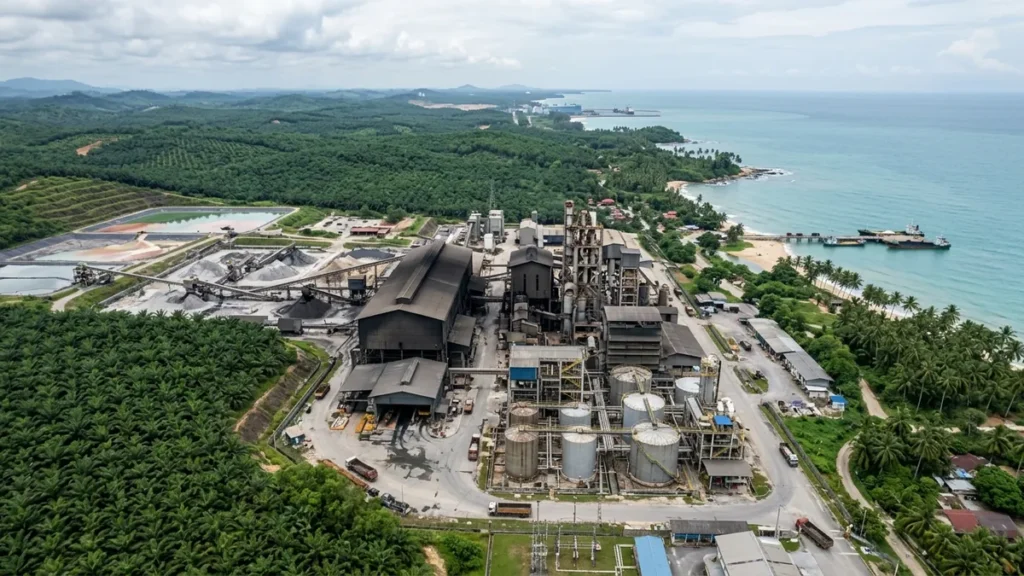
For more than a decade, Lynas Rare Earths (ASX: LYC) was the only serious answer to the question “who makes rare earths outside China?” It still is the largest. In the year to June 2026 it produced 7,260 tonnes of NdPr, earned A$222.4 million after tax on revenue of A$977.9 million, and ended the year with about A$1.2 billion in cash. It is also the only company outside China separating dysprosium and terbium at commercial scale. The questions for an investor today are less about whether Lynas works and more about how much of its future is already in the price, and how much it depends on one plant in Malaysia.
From an Australian mine to a Malaysian refinery
Lynas’s chain runs across two countries. Ore comes from Mt Weld in Western Australia, one of the richest rare earth deposits in the world. It’s processed into a mixed rare earth carbonate at Kalgoorlie, also in Western Australia, and then shipped to Kuantan in Malaysia, where it is separated into individual oxides such as NdPr, dysprosium, terbium and, since March 2026, samarium. Most of the value is created in that last step, which is why the Malaysian plant matters so much.
Unlike MP Materials or USA Rare Earth, Lynas doesn’t make magnets. It sells oxides to magnet makers and their customers, many of them in Japan, and is working with partners on metals and magnets rather than building them alone. If you’re weighing it against its American rival, our MP Materials vs Lynas comparison sets the two side by side.
A record year, then a record quarter
Financial year 2026 was the year rare earth prices recovered, and it shows in the numbers. Revenue rose 76% to A$977.9 million and net profit jumped from A$8.0 million to A$222.4 million, helped by a record average selling price. Lynas also raised about A$930 million from shareholders during the year, through a A$750 million institutional placement and a share purchase plan, which explains most of its cash pile. All of this comes from the company’s FY26 results announcement of August 26, 2026.
The first quarter of the new financial year, to September 30, 2026, went further. Lynas produced a record 2,082 tonnes of NdPr and 23 tonnes of dysprosium and terbium, and revenue reached A$310.1 million at an average price of A$102.1 per kilogram, 88% higher than a year earlier. The same report carried two warnings, though: sales volumes fell 17.7%, and planned maintenance in Malaysia and at Kalgoorlie will cut production in the December quarter, as MINING.COM reported on October 29.
The price floors changed the story
Rare earth producers have always had one big weakness: prices set in China that can halve in a year. In 2026 Lynas reduced that risk with two agreements. In March it signed a 12-year deal with Japan Australia Rare Earths (JARE), backed by the Japanese government agency JOGMEC and Sojitz, for 5,000 tonnes a year of NdPr with a floor of US$110 per kilogram. The same month it signed a letter of intent with the US government to redirect about US$96 million, originally meant for a heavy rare earth plant in Texas, into purchases of Lynas’s oxides over four years, again with a US$110 floor for NdPr. By the end of September, contracts with floor prices covered more than half of its production.
A floor isn’t a guaranteed profit. It protects the volumes covered if prices fall, and the JARE deal shares only part of the upside when NdPr goes above US$150. But it makes Lynas’s revenue far more predictable than in past cycles, when a price slump could wipe out its earnings. It also means the Texas plant, once part of the US strategy, is no longer on the table.
Heavy rare earths: the part no one else has yet
Dysprosium and terbium are added to magnets so they keep working at high temperatures, in electric motors for example, and China controls almost all of their supply. Lynas already separates both in Malaysia, in small amounts. It is now building a larger heavy rare earth facility there, with gadolinium due in early financial year 2028 and yttrium in early 2028. The bill has grown: the estimated cost rose from about A$180 million to about A$294 million, including contingency, according to the company’s June 2026 quarterly report. Japan has already secured a firm offtake for half of all the heavy rare earth oxides Lynas produces.
What could hold it back
- One country, one plant. Almost all of Lynas’s separation happens in Kuantan. Malaysia renewed its operating licence for ten years from March 2026, which removes the most immediate risk, but any disruption there hits the whole company.
- Ore and operations. Ore quality problems reduced throughput at Kalgoorlie and Kuantan in mid-2026, and the planned shutdowns mean the December quarter will look weaker.
- Leadership change. Amanda Lacaze, CEO for 12 years, announced her retirement in January 2026. Pol Le Roux has been interim CEO since June, and at its August results the board was still searching for a permanent replacement.
- Rising costs. The heavy rare earth expansion is already well over its first budget, and big projects in this industry rarely get cheaper.
- Expectations. Profit rose sharply because prices did. If NdPr falls back, the floors protect only part of the volume, and the share price, which reflects expectations of continued strong demand, could fall faster than earnings.
Owning it from outside Australia
Lynas’s main listing is on the ASX in Australian dollars, so for most investors elsewhere there’s also a currency effect: a stronger or weaker Australian dollar changes the value of the shares in your own currency. US investors can buy the ASX shares directly through a broker with Australian access, or use the over-the-counter lines. We explain the three routes, with their costs and trade-offs, in our guide on how to buy Lynas stock in the US.
For a company that spent years in survival mode, Lynas now looks like what it set out to be: a profitable, funded producer with government-backed customers on two continents. What a buyer is paying for today is the next step, heavier rare earths and higher volumes, delivered on time by a new management team. The December quarter, with its planned shutdowns, will be the first test of how the market treats a weaker set of numbers.