
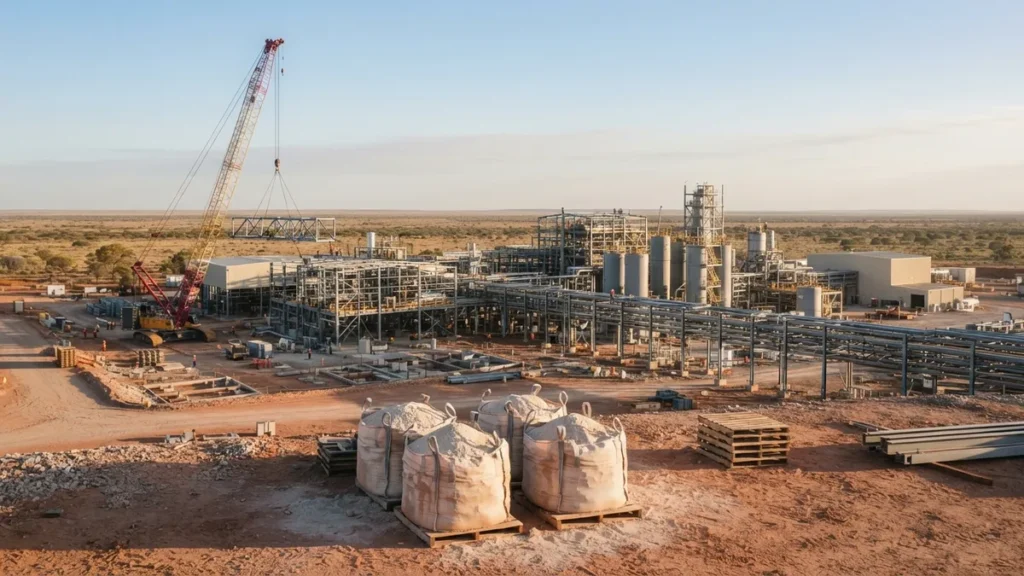
Lynas is already producing heavy rare earths outside China, and Iluka isn’t yet. In that sense the race has a leader. The real contest, though, is about volume and feedstock, not about who started first. Lynas produced 23 tonnes of dysprosium and terbium in the September 2026 quarter, under 100 tonnes a year at that pace. Iluka’s Eneabba refinery is designed for 750 tonnes a year, but on its own feed Iluka expects about 180. Both companies have more separation capacity coming than heavy rare earth ore to put through it. That gap is what investors should watch.
Where the two stand in November 2026
| Lynas Rare Earths (ASX: LYC) | Iluka Resources (ASX: ILU) | |
|---|---|---|
| Separating dysprosium and terbium today? | Yes, in Malaysia, since 2025 | No. Commissioning in 2027, ramp-up through 2028 |
| Recent heavy rare earth output | 23 t of dysprosium and terbium in the September 2026 quarter | None from the refinery yet, though Iluka produced on-specification dysprosium and terbium metal in the September 2026 quarter |
| Planned heavy capacity | New Malaysian facility for up to 5,000 t a year of heavy rare earth feedstock | 750 t a year of dysprosium and terbium oxide at nameplate |
| Main feed | Mt Weld, Western Australia, a deposit rich in light rare earths | Eneabba stockpile plus Balranald, with third-party feed still to be secured |
| Capital and funding | Heavy facility estimate raised from about A$180m to about A$294m, self-funded | A$1.7–1.8bn refinery, A$1,237m spent by September 30, 2026, with a government loan of up to A$1.65bn |
| Customers | Japan has a firm offtake for half of its heavy rare earth oxides | One automaker: 1,200 t of magnet oxides over four years from 2028, at least US$155m in revenue |
The bottleneck is feed, not plant
A separation plant can only produce the heavy rare earths that are in the material it receives. That’s the detail headline capacity figures hide.
Iluka. Eneabba’s 750 tonnes a year of dysprosium and terbium is a nameplate figure. As far back as its May 2025 investor briefing, Iluka’s worked example showed about 200 tonnes a year from its Eneabba stockpile alone. Its November 2026 site visit presentation set out three illustrative feed blends, as Discovery Alert reported:
- Eneabba stockpile plus Balranald: about 180 tonnes a year of dysprosium and terbium, with 3,700 to 3,900 tonnes of NdPr.
- A light rare earth blend: 350 to 400 tonnes of dysprosium and terbium.
- A heavy rare earth blend: 650 to 750 tonnes.
The second and third blends rely on projects that haven’t reached a final investment decision yet: Iluka’s own Wimmera deposit in Victoria, VHM’s Goschen project and Northern Minerals’ Browns Range in Western Australia. Browns Range is rich in xenotime, a heavy rare earth mineral, and is the key to the top of that range.
Lynas. Lynas has the opposite situation: a proven plant and a single great mine, but that mine is mostly light rare earths. Mt Weld gives Lynas its NdPr, and only a small share of heavy rare earths, which is why heavy output is counted in tens of tonnes a quarter. The new Malaysian facility is designed to take up to 5,000 tonnes a year of heavy rare earth feedstock. When Lynas announced it in October 2025, it said that would come from Mt Weld plus other sources still to be developed, including ionic clays in Malaysia. Gadolinium is due in early financial year 2028 and yttrium in early 2028. Lynas hasn’t said how many tonnes of dysprosium and terbium the expansion will produce, and that’s the number to look for.
Who is ahead, and on what
- Today’s production: Lynas, clearly. It’s the only company outside China selling separated dysprosium and terbium at commercial scale, and its Malaysian licence was renewed for ten years from March 2026.
- Potential scale: Iluka, on paper. Even its own-feed blend of about 180 tonnes a year would be roughly double Lynas’s recent pace. Reaching 750 tonnes depends on other companies building mines.
- Execution risk: Iluka carries more. Eneabba is a new, A$1.7–1.8 billion plant that has to be commissioned and then ramped up over two years. Lynas is adding a circuit to a plant that already runs, although that expansion has also gone well over its first budget.
- Concentration risk: both have it, in different places. Almost all of Lynas’s separation happens at one site in Malaysia. Iluka’s rare earth future rests on one refinery, and its earnings until then still depend on zircon and titanium.
Five things that would change the picture
- A final investment decision at Browns Range, the feed that unlocks Eneabba’s heavy rare earth capacity.
- The outcome of Iluka’s Wimmera feasibility study.
- Lynas announcing third-party heavy rare earth feed for Malaysia, or a tonnage target for dysprosium and terbium from the new facility.
- Eneabba starting commissioning in 2027 on schedule. Iluka has kept 2027 as its target throughout 2026.
- China’s export rules. If the suspended October 2025 package returns, or the April 2025 licences tighten, the value of heavy rare earth supply outside China rises for both.
For an investor, the two are different kinds of bet. Lynas is a producer with a large NdPr business, where heavy rare earths are a valuable but small extra. Iluka is a mineral sands company building a refinery designed for far more heavy rare earths than anyone outside China produces today, if the feed arrives. We look at each company in full in our Lynas Rare Earths stock review and in Is Iluka Resources a buy for rare earth exposure? The other companies trying to produce dysprosium and terbium are covered in our guide to dysprosium and terbium stocks.