
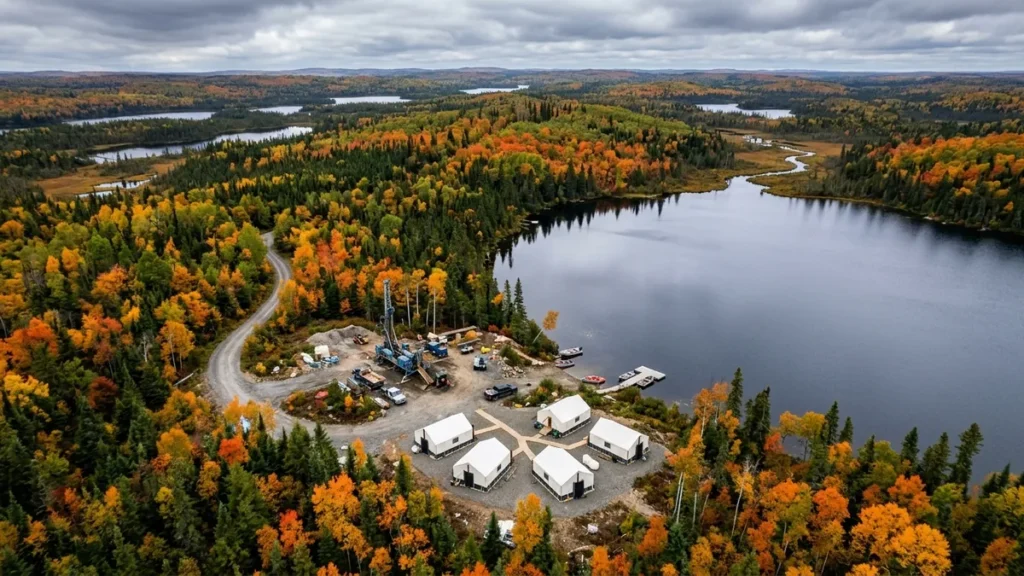
Canada’s stock exchanges, and the TSX Venture Exchange in particular, are home to a long list of small rare earth companies. Very few of them mine anything yet. What they offer instead is a set of different bets: a deposit in British Columbia, a separation technology being built in Louisiana, magnet recycling in Quebec and the UK, and projects in Africa and South America that happen to be listed in Toronto. Most will need far more money than they have today, which is why the right way to look at them is one company at a time, starting with what each one would actually sell.
Five juniors, five different bets
Ucore Rare Metals (TSXV: UCU): a separation plant, not a mine
Ucore’s main asset is a process, RapidSX, for separating rare earths, and a plant in Alexandria, Louisiana to use it. In May 2026 the company put the cost of the first production line at about $135 million for 3,000 tonnes a year of rare earth oxide, higher than earlier estimates, according to Mining Weekly. Part of it is covered by an $18.4 million agreement with the US Department of War. The investment case depends on two things: whether the technology works at commercial scale, and whether Ucore can secure enough feedstock from other companies’ mines.
Defense Metals (TSXV: DEFN): a Canadian deposit looking for a partner
Defense Metals owns Wicheeda, a carbonatite deposit near Prince George in British Columbia, close to rail, power lines and a gas pipeline. Its 2025 pre-feasibility study estimated an after-tax net present value of $992 million and an 18.9% internal rate of return, and a feasibility study is now under way. In July 2026 the board said it was reviewing strategic alternatives, from partnerships and government-backed financing to a sale of the company, while the shares traded at around 15 Canadian cents, as The Deep Dive reported. A strategic review can end in a deal, or in nothing at all.
Geomega Resources (TSXV: GMA): recycling magnet waste in Quebec
Geomega is building a demonstration plant in Saint-Hubert, near Montreal, to recover rare earths from magnet production waste. In June 2026 it received an environmental permit from Quebec that allows the plant to operate and collect data until the end of 2028, with construction expected to be largely finished by the end of the summer. It is a small company testing a process, so the question is whether the demonstration leads to a commercial plant and paying customers.
Mkango Resources (TSXV and AIM: MKA): a mine in Malawi and recyclers in Europe
Mkango combines two businesses. It owns the Songwe Hill rare earth project in Malawi, with an updated technical report filed in April 2026, and 79.4% of Maginito, which controls the HyProMag magnet recycling companies in the UK and Germany and half of a US joint venture. The company is in the middle of a merger with a US-listed SPAC, Crown PropTech Acquisitions, that would list the combined business on Nasdaq. In June 2026 the registration statement had not yet been declared effective by the SEC, so the deal was still pending.
Aclara Resources (TSX: ARA): Toronto-listed, Brazilian clay
Aclara is a reminder that “Canadian rare earth stock” can mean a project almost anywhere. Its flagship, Carina, is an ionic clay deposit in Goiás, Brazil, rich in heavy rare earths. The April 2026 feasibility study described an 18-year mine producing an average of 4,378 tonnes of rare earth oxides a year in a mixed concentrate, including 1,191 tonnes of NdPr, 156 tonnes of dysprosium and 27 tonnes of terbium. It put the initial cost at $780.9 million including contingency, with first production targeted for the second half of 2028. Aclara also plans its own separation plant in Louisiana. Neither the mine nor the plant is fully financed yet.
What they have in common
None of the five sells rare earths at commercial scale today, and all of them will need to raise much more money. Their studies show large net present values, but a net present value is a calculation built on price, cost and timing assumptions, not cash in the bank. The gap between a company’s market value and its study’s NPV usually tells you how much the market believes those assumptions. Each one also depends on something outside its control: a partner, a permit, a government loan or a customer willing to qualify a new supplier.
That’s why the same questions apply to all of them, whatever the story. We set them out in our seven-question checklist for junior rare earth stocks: what kind of deposit or technology it is, how far the studies have gone, who will pay for construction and who has agreed to buy the product.
Buying TSX Venture shares from outside Canada
Many TSX Venture companies also have an over-the-counter line in the US, which is easier to buy through a typical American broker but often trades in small volumes with wide gaps between buying and selling prices. Buying on the Canadian exchange itself gives you the main market, priced in Canadian dollars, but you need a broker with Canadian access. We compare which brokers offer this in our guide to the best brokerage for rare earth stocks.
Two more practical points. Shares in companies like these can lose or double their value on a single announcement, and small companies raise money often, usually by issuing new shares at a discount. Position size matters more than picking the “right” junior. If you’d rather follow how these projects move before buying anything, Ucore is one of the ten companies in our monthly rare earth producers tracker.