
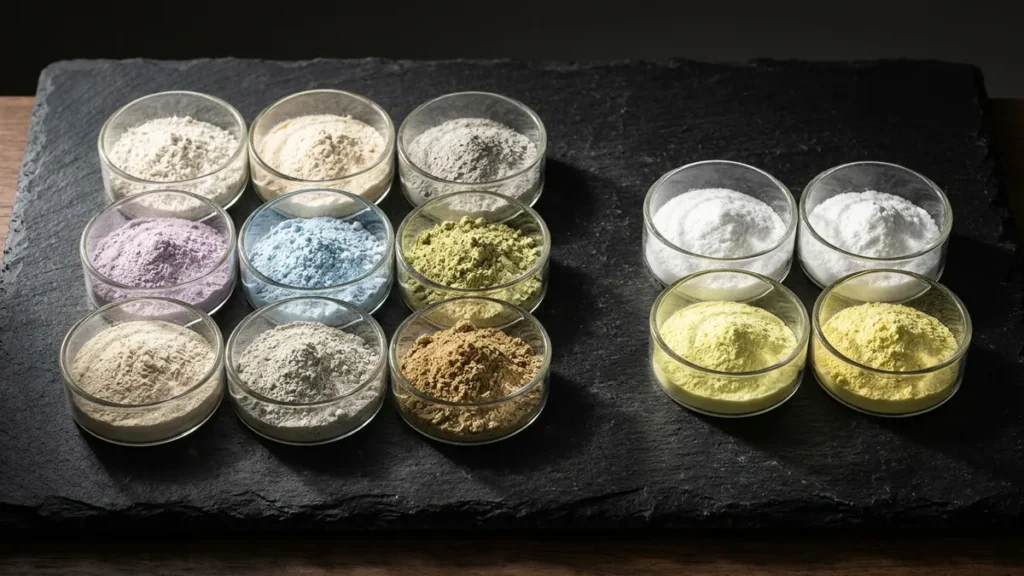
Light rare earths, led by neodymium and praseodymium, are where the volume is: they make up the bulk of most deposits and of the magnet market. Heavy rare earths, above all dysprosium and terbium, are where the scarcity is: there’s far less of them, they’re harder to separate, and China controls almost all of their supply. For an investor, the difference shows up in three places: what a deposit is really worth, how exposed a company is to Chinese export controls, and how wide the gap is between prices inside and outside China. By the end of September 2026 that gap was around sixteen to one for dysprosium.
Where the line falls
There is no single official dividing line, which is why you’ll see slightly different lists. The usual split follows the periodic table. The light group runs from lanthanum to samarium or europium. The heavy group runs from gadolinium or terbium to lutetium, and yttrium is counted with them because it behaves like a heavy rare earth chemically. Some reports add a “medium” group in between for samarium, europium and gadolinium. Scandium is often treated separately. If you want a refresher on all seventeen, our rare earth elements explainer walks through them.
What matters more than the exact boundary is which elements carry the value. In magnets, that means NdPr on the light side and dysprosium and terbium on the heavy side. Dysprosium and terbium are added in small amounts so that magnets keep their strength at high temperatures, which is what electric motors, wind turbines and many defense systems need.
Four differences that matter for investors
1. Geology. Most large hard-rock deposits, such as Mountain Pass in California or Mt Weld in Australia, are rich in light rare earths and poor in heavy ones. Mountain Pass, for example, contains less than 1.8% medium and heavy rare earths, according to Reuters. Higher heavy grades are typically found in ionic clay deposits, which are concentrated in southern China and Myanmar, and in a smaller number of hard-rock deposits elsewhere.
2. Processing. Rare earths are chemically very similar, so separating them takes many stages, and the heavy ones are among the hardest to split from their neighbors. Benchmark Mineral Intelligence has estimated that refining heavy rare earths outside China costs five to seven times more than in China, as reported by MINING.COM. The same report cited Benchmark’s estimate that the West relied on China for 99% of its heavy rare earth needs in 2024.
3. Policy. China’s April 2025 licensing rules apply to seven medium and heavy rare earths, including dysprosium and terbium, and they stayed in force even while a broader package of controls was suspended. In November 2026 China extended that suspension to January 10, 2027, so heavy rare earths remain at the center of every round of trade talks. We track what’s in force in our guide to China’s rare earth export controls.
4. Price. Heavy rare earths cost far more per kilogram than light ones, and since the export controls they have two prices: one inside China and a much higher one outside it. At the end of the third quarter of 2026, Benchmark put dysprosium oxide delivered to Europe at about $3,500 per kilogram, while the Chinese domestic price was around $210 in late October. Terbium oxide was about $6,745 in Europe and under $1,000 in China, according to figures compiled by TechTimes. For comparison, NdPr oxide traded around $100 per kilogram in China in mid-2026.
How to read a deposit with this in mind
Company presentations usually lead with total rare earth oxide, or TREO, and tonnage. Those two numbers say little about value on their own, because a tonne of cerium and a tonne of terbium are worth very different amounts. Three questions help:
- What share of the rare earths is NdPr, and what share is dysprosium plus terbium? This “basket” usually explains most of a deposit’s value. Look for the distribution table in the resource statement, not just the headline grade.
- Which price does the project assume for its heavy rare earths? A study that values dysprosium at ex-China prices looks much better than one using Chinese domestic prices. Neither is wrong, but the gap is large and could narrow if more supply arrives outside China or export rules change.
- Who will separate the heavy rare earths? Mining them is only the first step. A project without a clear route to a separation plant outside China may end up selling into the same Chinese system it was meant to bypass.
Who has heavy rare earth exposure outside China
The list is short. Lynas already separates dysprosium and terbium in Malaysia at commercial scale, in small volumes. USA Rare Earth, through the Serra Verde mine in Brazil, produces material containing heavy rare earths. Iluka is building a refinery at Eneabba in Western Australia designed to handle them from 2027, and Northern Minerals plans to supply it from its Browns Range project. Energy Fuels and MP Materials are adding heavy rare earth circuits to plants built mainly for light rare earths. We look at these companies and their plans in our guide to dysprosium and terbium stocks.
The trade-off is the same as everywhere in this sector, only sharper. Heavy rare earths offer the scarcest products and the highest prices, but in tiny volumes, with hard chemistry and prices that depend heavily on decisions in Beijing. Light rare earths are where the tonnes and most of the revenue are, with more competition and prices that have already swung widely. Most companies outside China earn the bulk of their money from NdPr and treat heavy rare earths as the valuable extra, and that’s usually the right way to read their plans.