
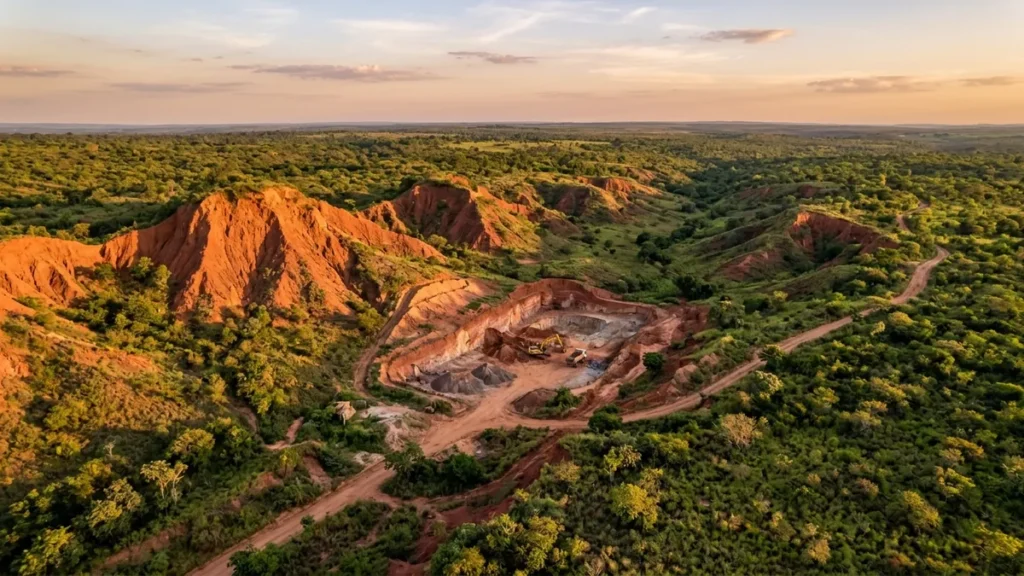
Brazil has the world’s second-largest rare earth reserves after China, but it produces almost none of them yet. One mine, Serra Verde, is running, and it is now owned by a US company. Behind it sits a queue of projects, most of them in ionic clay deposits rich in the heavy rare earths that are hardest to find outside China. For investors, that makes Brazil one of the more interesting places to watch, with a clear catch: almost every Brazilian rare earth stock is a developer, and none of the new mines is likely to produce before 2028.
Why Brazil matters
Two things set Brazil apart. The first is size. In 2026 Brazil’s National Mining Agency revised its estimate of the country’s rare earth reserves to about 11.4 million tonnes, down from 21 million, which still leaves it second only to China. The second is geology. Several of the most advanced projects are ionic clays, the same type of deposit that supplies much of the world’s dysprosium and terbium from southern China and Myanmar. Clays are usually lower grade than hard-rock deposits, but they can be simpler to mine and process. If you want the background on why heavy rare earths matter, our guide to heavy vs light rare earths explains the difference.
Production, though, is tiny: about 20 tonnes in 2024, under 0.1% of the world total, according to a September 2026 factsheet from Brazil’s Observatório da Mineração. The same report lists ten rare earth projects pre-selected for state financing, but notes that no funds had been released by mid-2026.
The one producer: Serra Verde
Serra Verde’s Pela Ema mine in Goiás started commercial production in 2024 and is the only rare earth mine operating in Brazil. In September 2026 it became part of USA Rare Earth (Nasdaq: USAR), in a deal valued at about $2.8 billion, with its output of magnet rare earths committed under a long-term offtake to a buyer backed by the US Department of War. So the only way to own Brazil’s producing rare earth mine on the stock market is now through a US company. We look at what else USA Rare Earth owns in our USA Rare Earth stock review.
The developers
- Aclara Resources (TSX: ARA), Carina, Goiás. Its April 2026 feasibility study describes an 18-year ionic clay mine producing an average of 1,191 tonnes of NdPr, 156 tonnes of dysprosium and 27 tonnes of terbium a year in a mixed concentrate, for an initial cost of $780.9 million including contingency. The company targets first production in the second half of 2028 and plans to separate the concentrate at its own plant in Louisiana. Neither is fully financed yet.
- Meteoric Resources (ASX: MEI), Caldeira, Minas Gerais. Its definitive feasibility study, published in July 2026, put the initial cost at $498 million and average output at about 3,860 tonnes of NdPr and 127 tonnes of dysprosium and terbium a year. It holds a preliminary licence; the installation licence, needed for construction and expected in the fourth quarter of 2026, must come before a final investment decision.
- Viridis Mining and Minerals (ASX: VMM), Colossus, Minas Gerais. Also in the Poços de Caldas area, Colossus completed its definitive feasibility study in August 2026, when Viridis announced commitments of up to $120 million in new equity. It is targeting a final investment decision in the fourth quarter of 2026, subject to its installation licence and debt financing.
- Brazilian Rare Earths (ASX: BRE), Rocha da Rocha, Bahia. Earlier stage. Its August 2026 scoping study estimated $969 million in upfront capital to first oxide production, with first sales targeted for 2030 to 2031, subject to further studies, funding and permits.
Two things stand out in this list. Most of these companies are listed in Australia or Canada rather than Brazil, so investors buy Brazilian geology through foreign exchanges. And most plan to sell a mixed concentrate, not separated oxides, which means someone else, often outside Brazil, still has to do the separation.
Policy and politics
Brazil launched a national critical minerals policy in September 2026. According to Canadian Mining Journal, it gives the government more oversight of changes in control of strategic mineral assets and of international supply agreements, and offers tax credits of up to 20% on eligible processing spending from 2030 to 2034, capped at 1 billion reais a year and subject to government approval. The policy’s emphasis is on processing and refining inside Brazil, not only exporting concentrates.
Politics adds another layer. Luiz Inácio Lula da Silva won Brazil’s presidential runoff on October 25, 2026, with his new term starting in January 2027. The same report notes that foreign companies, mainly from Australia, the US and Canada, filed 42% of the country’s rare earth exploration applications through June. How the new rules are applied to those companies, including deals like Serra Verde’s sale to a US buyer, is one of the open questions for every project on this list.
What to check before buying a Brazilian rare earth developer
- Which licence does it hold? In Brazil a project usually moves from a preliminary licence to an installation licence before construction, and to an operating licence before production. The installation licence is often the step that unlocks financing.
- Who will separate the concentrate? A mixed concentrate is worth far less than separated oxides, and the buyer determines how much of the value the miner keeps.
- Which prices does the study use? Heavy rare earths now trade at much higher prices outside China than inside it. A study built on ex-China prices looks very different from one built on Chinese prices. You can see the gap for Caldeira and Colossus in our rare earth deposit value calculator.
- How much money is still missing? Compare the capital cost with the cash, equity commitments and debt actually signed, not just letters of interest.
Brazil may well become one of the main sources of rare earths outside China in the next decade. For now, nearly all the opportunity on the stock market is in projects, with the dilution, delays and permit risk that projects carry.