
If you’re looking for a rare earth royalty or streaming company, the short answer is that one doesn’t really exist yet. None of the listed royalty companies earns meaningful income from rare earths today. The closest thing is Ecora Royalties, which owns a small royalty on a South African project that isn’t producing yet. Most rare earth royalties are held by private funds, and the largest royalty-like deal in the sector belongs to the US government. Here is where that exposure sits, why royalty companies have mostly stayed away, and what it means if you own the miners instead.
How a mining royalty works, using a real rare earth deal
A royalty company pays a miner cash up front. In exchange, it receives a percentage of the mine’s future revenue or production, usually for the life of the mine. It doesn’t pay construction or operating costs. That’s why royalty stocks are popular in gold: investors get exposure to the metal price and to new discoveries without most of the cost overruns that hit miners.
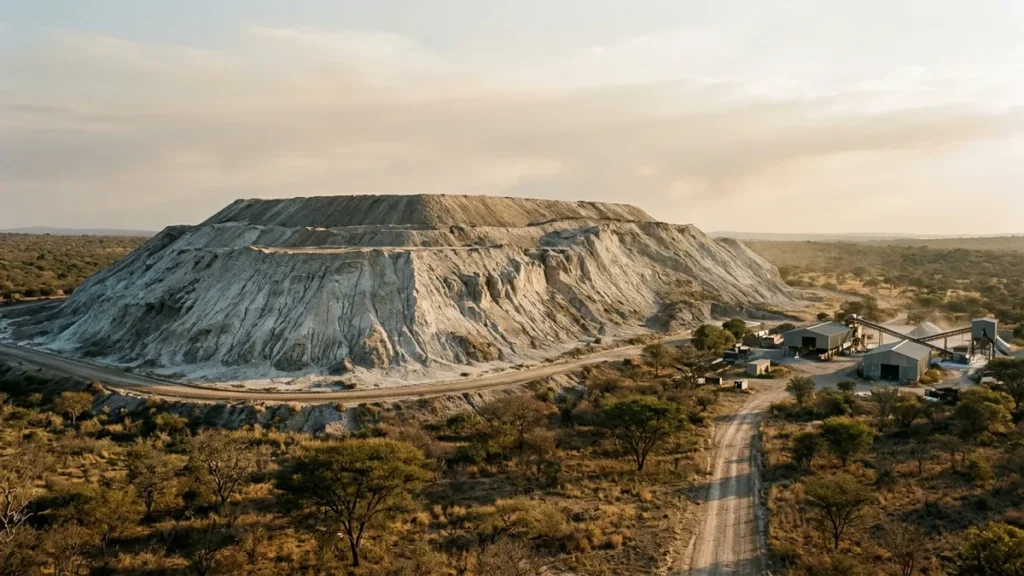
The best example in rare earths is small. In July 2024, Ecora paid Rainbow Rare Earths (LSE: RBW) $8.5 million for a 0.85% gross revenue royalty on the Phalaborwa project in South Africa, and bought about $1.5 million of Rainbow shares at the same time, as Engineering News reported. Phalaborwa plans to recover rare earths from old phosphogypsum stacks left by fertiliser production. At the time, its target was 1,750 tonnes a year of NdPr oxide, plus 60 tonnes of dysprosium and 20 tonnes of terbium oxide.
Two details show how royalty holders protect themselves. The rate rises to 0.95% if production hasn’t started by October 1, 2027, and to 1.1% if it hasn’t started by July 1, 2028. And the money was raised to fund a definitive feasibility study then expected in the first half of 2025. In its 2025 results, published in March 2026, Ecora said that study was now targeted for 2026. Delays are normal in this sector, and the royalty contract was written with that in mind.
Where royalty-style exposure to rare earths actually exists
1. Ecora Royalties: a listed company, a tiny rare earth slice
Ecora (LSE and TSX: ECOR, OTCQX: ECRAF) calls itself a critical minerals royalty and streaming company. In 2025, its portfolio contributed $57.0 million, mostly from copper, the Voisey’s Bay cobalt stream and the Kestrel coal royalty. Phalaborwa contributed nothing, because it isn’t built yet. Buying Ecora for rare earths would mean buying a copper and cobalt business with a rare earth option attached.
2. Private funds: the Serra Verde royalty
Brazil’s only producing rare earth mine, Serra Verde’s Pela Ema, carries a 2.625% royalty on its sales, which can fall to 2.375% once certain milestones are met. It was sold to funds managed by Orion Mine Finance, a private investor, for $40 million paid in two tranches, according to Serra Verde’s financial statements filed with the SEC by USA Rare Earth. The royalty is perpetual, and Serra Verde’s own accounts valued the obligation at $73.0 million at the end of 2025.
Ordinary investors can’t buy into Orion’s fund. But since USA Rare Earth bought Serra Verde, its shareholders now own a mine with about 2.6% of its revenue already committed to someone else. That cost is worth remembering when you read our USA Rare Earth stock review.
3. The US government: a royalty in all but name
The biggest royalty-like arrangement in the sector isn’t held by a royalty company at all. Under its July 2025 agreement with the Department of Defense, MP Materials is guaranteed $110 per kilogram for its NdPr for ten years. When the market price is above that floor, the government takes 30% of the difference. At $150 per kilogram, for example, it would receive $12 of the $40 above the floor on every kilogram. That’s not a legal royalty, but for MP shareholders it works like one on the upside. We cover the rest of the deal in Is MP Materials a good investment?
Why royalty companies have mostly stayed away
Royalties work best with products that have a clear price and a deep market, like gold, silver and copper. Rare earths have neither. Each mine produces a different mix of up to sixteen elements, and much of it is sold as a mixed concentrate whose price depends on a negotiated contract rather than a public quote. Since China’s export controls, the heavy rare earths also have two prices, one inside China and a much higher one outside it. A royalty holder has to agree, in advance, which of those prices its share is calculated on.
The projects themselves are another obstacle. Most rare earth projects outside China are still years from production, need separation plants that are hard to build, and depend on permits and government financing. A royalty on a project that never gets built pays nothing. That’s why the deals that do exist are small, like Ecora’s, or come with protections, like the rising rate on Phalaborwa and the minimum payments on Serra Verde.
If you own the miner, read the royalty section
For most readers, royalties matter less as an investment and more as a cost buried in the companies they already own. Three things are worth checking in any feasibility study or annual report:
- Who takes a cut of revenue before costs. Government royalties, private royalties and price-sharing deals all come off the top. A 2.6% gross royalty takes about $2.6 million of every $100 million in sales, whether the mine is profitable or not.
- What price the royalty is calculated on. For a project rich in dysprosium and terbium, the difference between Chinese and ex-China prices can change the royalty bill, and the mine’s revenue, many times over. Our deposit value calculator shows how much of a deposit’s value depends on that choice.
- Whether the terms get worse with delays. Step-up rates and minimum payments shift risk from the royalty holder to the miner, and from the miner to its shareholders.
Royalty investing in rare earths may grow as more mines outside China reach production. For now, there’s no listed company that gives you clean, royalty-style exposure to the sector. The rare earth royalties that matter sit in private funds and government contracts, and their cost shows up in the share price of the miners you already own.